Starlink throttling in Ukraine and the ally who owns the switch
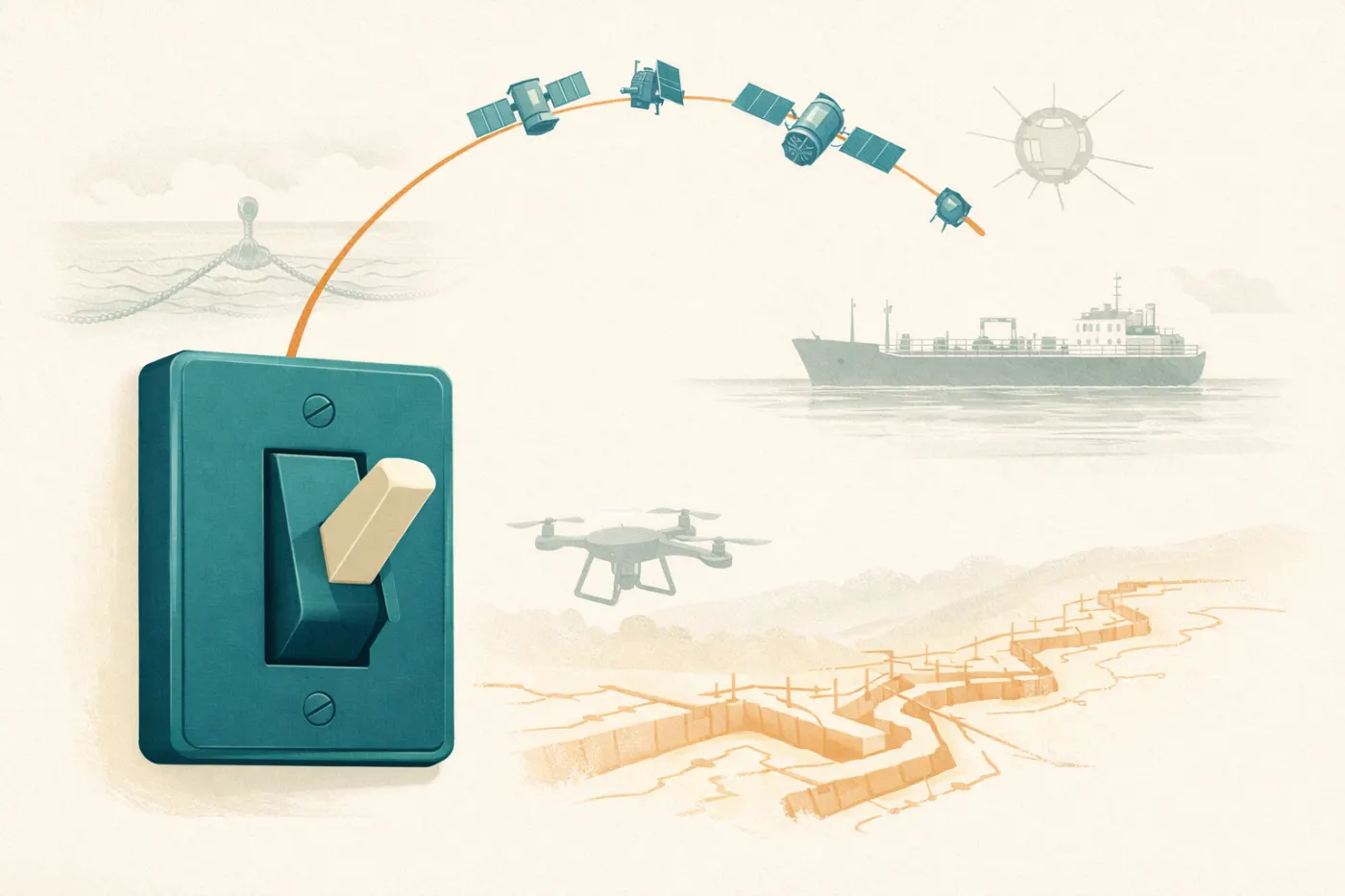
A ten-day Starlink speed cap disrupted Ukraine's drones and revived an old lesson: allies who own the switch use it, and sovereign fixes take years.
By Rhyme Desk3 min read11 sourcesRhyme index 68
For ten days in October, Ukrainian military terminals moving faster than about 160 km/h lost their Starlink connection, disrupting drone missions until speeds above 400 km/h were restored on 24 October.
What happened
Overnight on 13–14 October, Ukrainian military terminals travelling faster than about 160 km/h began dropping their connection. Serhii Beskrestnov, President Zelenskyy's adviser on defence technology, said the cap applied to Starshield, the military service package. On 17 October Zelenskyy said: "The maximum speed today is 161 km/h; after exceeding it, Starlink shuts down, and we lose the drone." He added that terminals tested at 180 km/h inside the EU kept working.
Before the cap the system had worked on drones flying at up to 400 km/h. Officials reported cancelled missions, lost drones and weaker interception of jet-powered Shaheds. The 7th Rapid Reaction Corps said drones "kept flying, but the interruptions made them harder to control." The measured effect was smaller than the anecdotes suggest: the Institute for the Study of War found Ukraine downed about 74% of turbojet Shaheds during the cap, against a typical 77%, with F-16s covering much of the gap.
Responsibility remains contested. On 14 October Musk posted that Starshield is "owned and controlled by the US government" and that limits are "decided by the US military and ultimately POTUS." Trump said on 16 October, "I didn't do that," the same day the Telegraph reported that he had approved a throttle Musk proposed. The Wall Street Journal later reported that Musk ordered the slowdown and that Trump called him on 22 October to ask for it to be lifted. Secretary of State Marco Rubio said the decisions were up to SpaceX.
On 24 October the Defence Ministry recorded a stable connection above 400 km/h. Musk then wrote that Ukraine's military had "violated Starlink terms of service" by using a civilian service for offensive strikes, and that the "loophole was closed." Beskrestnov disputed this, saying civilian Starlink on Ukrainian drones was already capped at 70–90 km/h and does not work in Russia.
In Istanbul on 23 October, Canadian Prime Minister Mark Carney said the slowdown had "real consequences" and that Canada is "highly, highly reliant on certain systems in certain countries," adding that Canadians do not want to rely "on one provider that may change their view, or may be forced to change their views, by one nation state." Eutelsat shares jumped after its chief executive said its service was already available in Ukraine for drones.
Why it matters
The episode showed that a single supplier, sitting at the junction of a private company and a government, can change the performance of a front line overnight and without notice. Whether the order came from SpaceX, the White House or both, the effect for Ukraine was the same.
It also moved the question beyond Ukraine. Canada, European governments and arms makers now treat satellite connectivity as a dependency to be managed, not a utility to be assumed. The practical question is how quickly any of them can replace it.
The rhyme
The pattern is the ally who owns the switch. In 1956 Washington withheld support for sterling until Britain left Suez; in 1982 France cut off Argentina's Exocet supply mid-war; in 1999, according to Indian officials, the US declined India's request for GPS data during the Kargil conflict. Musk's refusal to extend Starlink coverage near Crimea in 2022 is the closest precedent of all.
The record is consistent on one point: dependent states vow independence quickly and achieve it slowly. India's NavIC took roughly 17 years from Kargil to a complete constellation; Galileo and BeiDou took similar spans. In the meantime the choice is usually between drawing closer to the switch owner and spreading reliance across other suppliers. Europe's IRIS² is targeted for around 2030 and Telesat's Lightspeed is the Canadian test, so the next year will be decided by existing alternatives such as Eutelsat OneWeb.
The patterns below are the historical set-ups this story most resembles. The score is a 0–100 measure of how closely the conditions match; the "where it breaks" note is as important as the match.
A partner controls a system a state depends on in war or crisis and restricts it to pursue its own aims. The dependent state, or an observer that draws the lesson, vows independence. Sovereign replacements usually arrive a decade or more later; in the short run the dependent either aligns more closely with the switch owner or loses the capability when it matters.
ThenA state at war or in crisis depends on a partner for a critical system: money, missiles, navigation or communications. Mid-crisis the partner restricts access to pursue its own policy aims, and the dependent state discovers the limits of its autonomy at the worst moment.
NowUkraine relies on SpaceX's Starlink and Starshield for drone control and front-line logistics. A ten-day speed cap, linked in reporting to Musk and possibly the White House, disrupted operations before being lifted, and Canada and Europe are openly reassessing their own reliance.
Where it breaks: The switch owner is a private firm entangled with a government, and commercial alternatives such as Eutelsat OneWeb already operate in Ukraine, unlike India in 1999. That pushes towards faster diversification than the historical base rate, though fully sovereign systems remain years away.
Sabato's Crystal Ball rates 225 House seats at least lean Democratic, prediction markets put Democrats at 91% for the House and 65% for the Senate, and Trump calls the polls fake. Since 1934 the president's party has lost House seats in 20 of 23 midterms.
The sixth strike on the airport in a month came after an evacuation warning and as government forces, backed by Saudi air power, opened an offensive towards the Red Sea coast near Bab el-Mandeb.