Skip to content
rhyme.news
Thursday 29 October 20269 stories16 patterns in the libraryEvery story cross-referenced with the historical record
Historical pattern · 1840 – 2015

The jobs nobody could name

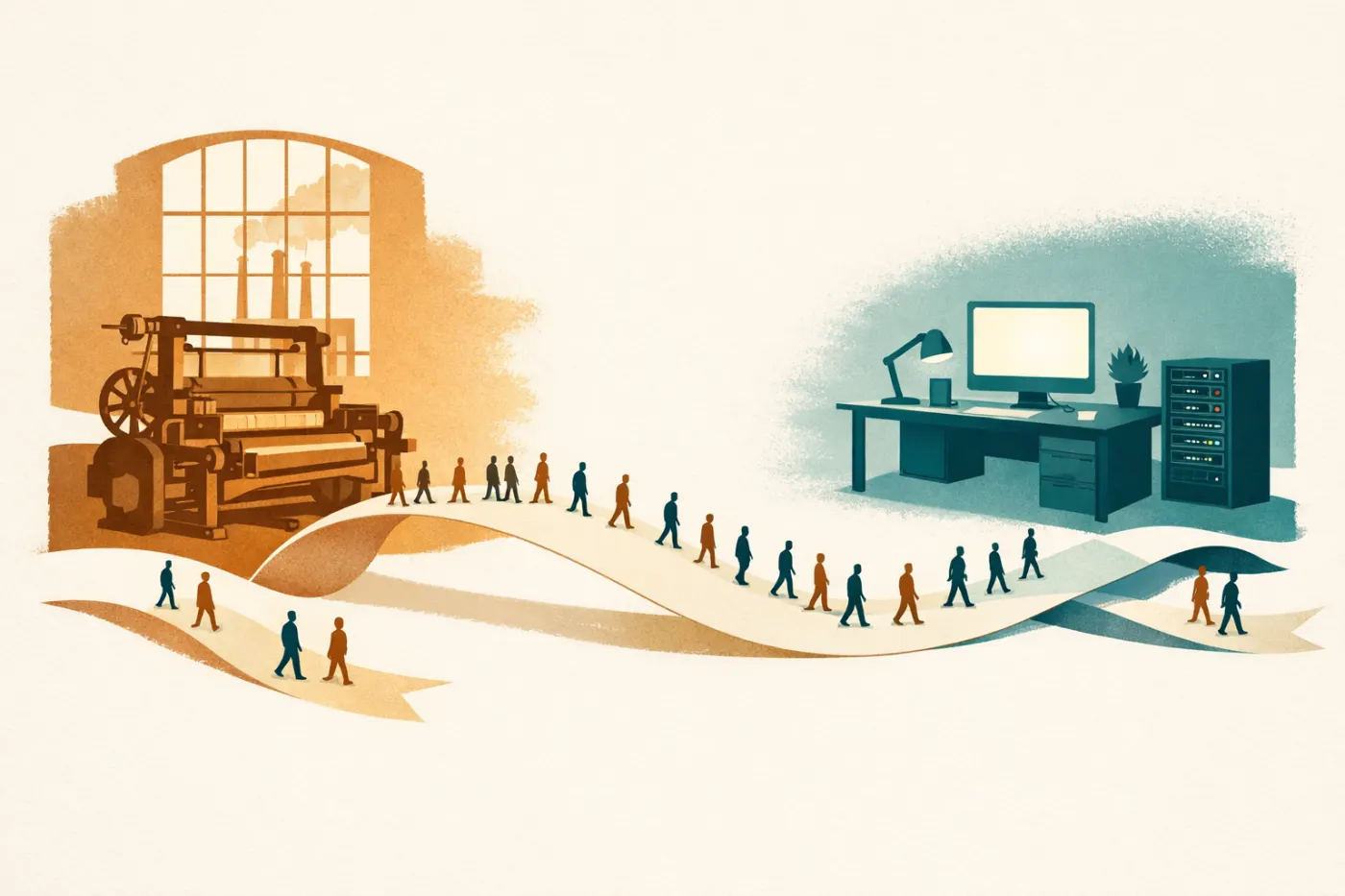
Each wave of technology destroys visible occupations and creates invisible ones. The new work rarely appears where the old work was lost; it comes from second-order effects, from a collapse in the cost of something that creates demand for things nobody had thought to want. By one careful count, about 60% of the jobs Americans held in 2018 had titles that did not exist in 1940.

The cases

4 episodes
  1. 1840

    The railway

    In 1830 almost nobody worked on railways. The machine threatened carters, canal boatmen and coaching inns.

    What happened next: By the early twentieth century Britain's railways employed more than half a million people in occupations invented for them: engine driver, signalman, booking clerk, guard. The bigger effect was indirect: commuter suburbs, seaside resorts, the daily newspaper and national brands all depended on cheap, timetabled movement.new occupations

  2. 1900

    Electrification

    Electric power threatened the gas industry, the steam engineer and the millwright, and the first factories simply swapped a steam engine for an electric one.

    What happened next: It took about forty years for factories to be rebuilt around distributed power, a lag the economist Paul David compared to the slow payoff from computers. When it came, it created the electrician, the lineman, the appliance trades, radio and the modern consumer goods industry.new occupations after a lag

  3. 1950

    The computer

    Early forecasts had computers replacing clerks and calculators, which they did. 'Programmer' was not a civilian occupation in 1945.

    What happened next: By the 2020s several million Americans worked in computer occupations that did not exist in 1950, and the clerk did not vanish so much as change: the machines made information cheap, and the demand for people to decide what to do with it grew.new occupations

  4. 1995

    The internet

    The web threatened travel agents, newspaper classifieds, record shops and bank branches, and took most of them.

    What happened next: It also created the web developer, the search-marketing specialist, the app developer, the social-media manager, the ride-hail driver and the warehouse picker, almost none of which appeared in any forecast made in 1995.new occupations

How these cases resolved

Most new employment lands in occupations unnamed at the start75%
The technology mainly thins existing occupations without creating a new category25%

Share of the 4 cases above that resolved this way. Small samples: treat as a prior, not a forecast.

Signals that mark this pattern
  • Forecasts that count the jobs at risk but cannot name the jobs to come
  • A steep fall in the cost of a core input (movement, power, calculation, information)
  • The first uses of the technology copying the old process rather than redesigning it
  • New job titles appearing first in small firms and official statistics catching up years later
The lesson
The jobs that replace the lost ones are not found by looking at the lost ones. They come from whatever the technology makes cheap enough to want more of.

Stories echoing this pattern

AI at work rhymes with the Industrial Revolution: what to expect next

Microsoft is offering buyouts to 60,000 staff and the youngest workers in AI-exposed jobs are falling behind. History's three great labour transitions say what usually follows, and where the unknowns hide.

Outlook: Churn without collapse: aggregate employment holds, junior white-collar hiring stays depressed, new titles emerge 45% · 5 years, to 2031
·9 min read