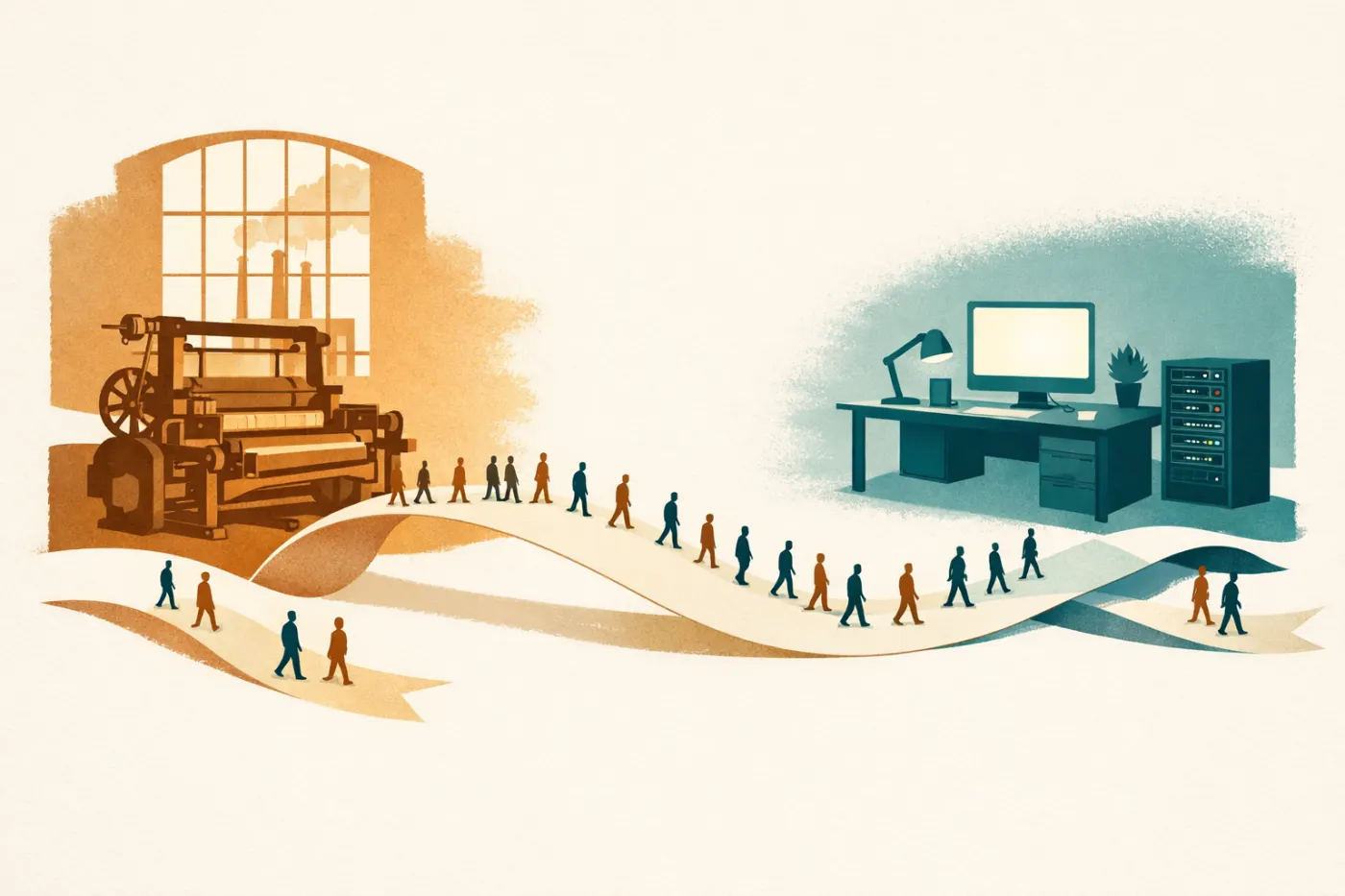
AI at work rhymes with the Industrial Revolution: what to expect next
Microsoft is offering buyouts to 60,000 staff and the youngest workers in AI-exposed jobs are falling behind. History's three great labour transitions say what usually follows, and where the unknowns hide.
By Rhyme Desk9 min read17 sourcesRhyme index 70
The week's news from the AI workplace comes in two registers: large employers trimming white-collar headcount while spending record sums on machines, and a running argument among economists about whether the youngest knowledge workers are already being squeezed out.
What happened
On Monday Microsoft offered voluntary buyouts to about 60,000 employees, roughly 27% of its 223,000-strong workforce, according to CNBC and TechCrunch. Staff at vice-president level and below on selected teams in the United States, Canada, India and the United Kingdom can apply; Bloomberg reported that Xbox, Windows, Copilot and Finance are taking part while data-centre, sales and marketing staff are excluded. Those who accept get a minimum of eight weeks' pay in the US, continued stock vesting and health cover, and must decide by early December before leaving on 31 December. The company framed the offer as balancing its AI infrastructure build-out with "capital efficiency". It follows a voluntary retirement programme in April and 4,800 layoffs in July.
Microsoft is the largest example of a wider move. Barclays has said it will cut about 5,000 jobs, around 5% of its workforce, by year-end, with its chief executive linking the reductions to the bank's technology investment and about 60% of them falling in support functions. Meta plans to eliminate about 8,000 roles and leave 6,000 unfilled while raising spending on AI infrastructure and specialist hiring. Kroger has said it will shed 3,000 corporate jobs over three years as it expands its use of AI. One tracker, Skillsyncer, counts 567 tech-sector layoff events in 2026 affecting about 233,000 workers as of 28 October, and says 37% of them explicitly cite AI, automation or machine learning.
The attribution is contested. Harvard Business Review argued in January that companies are cutting for AI's potential rather than its performance, and critics note that AI offers a socially acceptable reason for reductions that tariffs, offshoring and pandemic-era overhiring would explain just as well. Amazon, for instance, cut fewer than a thousand corporate jobs this month and cited priorities and overstaffing, not AI.
The data under the headlines
Two sets of numbers matter more than the layoff announcements. The first is productivity. The Bureau of Labor Statistics reported nonfarm business productivity up 1.4% in the second quarter, and 2.1% a year on average since the end of 2019. The Dallas Fed puts growth since early 2024 at 2.4% annualised, with the three most AI-exposed sectors growing at 3.7% against 1.7% for the rest of the economy, a correlation it is careful not to call a cause. A Bureau of Economic Analysis working paper finds total-factor-productivity growth about two points a year higher in high-AI-intensity industries. A Richmond Fed survey of chief financial officers puts AI-attributed productivity growth at about 0.6% in 2025, rising in 2026, and expects AI-related headcount reductions this year of roughly 500,000, under 0.4% of the workforce.
The second is who is being hired. A Stanford Digital Economy Lab study using ADP payroll data finds employment of 22-to-25-year-olds in the most AI-exposed occupations running about 19% behind their less-exposed peers in its August update, up from 13% a year earlier, with the gap driven by fewer hires rather than layoffs. An April Census Bureau paper found hiring of 22-to-24-year-olds falling sharply in the most exposed industries while holding steady elsewhere. Fortune reported in September that graduates from AI-exposed majors are turning up in retail and food service.
Against that, a September NBER working paper by Fairlie and Wu of UCLA found no spike in unemployment among recent graduates this summer, with the rate for 22-to-25-year-old degree holders at 7.3%, and work from the New York Fed and the London School of Economics attributes most of the rise in graduate unemployment since 2022 to remote and hybrid work rather than to AI. The two findings can both be true: payroll data in exposed occupations shows a narrowing first rung, while household surveys show graduates finding other work.
The first rhyme: the pause
The strongest echo in this week's news is not the layoffs but their pairing with capital spending. Microsoft is shedding people to fund data centres. Barclays is cutting support staff to pay for technology. Alphabet reported negative free cash flow this week because of a $51 billion quarter of capital expenditure. That is the signature of the Engels' pause: output per worker rising, the returns flowing to the owners of the new machines, and pay for the median worker standing still while the argument rages over whether the technology is 'really' in the statistics yet.
Three of the four pauses in the record lasted twenty years or more. The one exception, the postwar boom, shared its gains within the decade because workers had bargaining power and labour markets were tight. Neither condition describes today's junior knowledge worker. The practical implication is that even if AI delivers the productivity growth its champions promise, the default path is that it shows up in profits, in the pay of the people who direct the machines, and in cheaper services, well before it shows up in most pay packets.
The second rhyme: the jobs nobody could name
In 1830 it was obvious which jobs the railway would destroy: the carter, the canal boatman, the coaching inn. Nobody could name the engine driver, the signalman or the booking clerk, let alone the commuter, the seaside landlady or the national newspaper. Electrification spent forty years being a cheaper steam engine before factories were rebuilt around it and the electrician, the appliance trade and radio appeared. 'Programmer' was not a civilian occupation in 1945. The web developer, the search marketer and the ride-hail driver were in no forecast made in 1995.
David Autor and colleagues have put a number on this: about 60% of the jobs Americans held in 2018 had titles that did not exist in 1940. The pattern has two parts that matter now. First, the new work does not appear where the old work was lost; it appears wherever the technology collapses the cost of something and creates demand for more of it. Second, the first use of a new technology always copies the old process, and the real reorganisation comes a generation later.
Applied to AI, that means the jobs to watch are not 'prompt engineer' or 'AI trainer', which are the signalman and the booking clerk of this wave: real, but small. The large unknowns are in whatever becomes cheap enough to want more of when cognitive work costs almost nothing. Personalised tutoring, legal representation for people who never had it, medical triage and monitoring, bespoke software for businesses too small to afford a developer, and a great deal of translation, design and analysis that was previously never done at all. Each of those, if it materialises, carries a human layer with it: the people who verify, insure, deliver and take responsibility for what the machines produce. The railway's biggest employer was not the railway company; it was everything that became possible because of it.
The third rhyme: the scare
Every generation since the Luddites has been told that machines were about to end work: Keynes in 1930, the Triple Revolution memorandum in 1964, 'The End of Work' in 1995, the 47% estimate in 2013. In the aggregate the prediction has failed every time. The commission President Johnson appointed concluded in 1966 that technology 'eliminates jobs, not work', and unemployment fell to 3.5% within three years. The same number was reached again in 2019, six years after nearly half of all jobs were declared at risk.
But the scare has usually been right about someone. Cashiers and telemarketers did shrink. Bank tellers doubled in number for forty years after the cash machine, then declined once banking moved online. And in the one case where the scare was most right, the handloom weavers, the adjustment was brutal: some 240,000 of them in the 1820s saw their earnings fall by more than half over the following decades before the occupation vanished in the 1850s. The textile industry employed more people throughout. The weavers were not helped by that.
The question this pattern poses is not whether work will end but which occupation is this wave's handloom weaver. The payroll data gives an early answer: the junior analyst, the junior developer, the paralegal and the entry-level marketer, the roles whose core task is codified knowledge work and whose purpose was partly to train the next generation. A narrowing first rung is exactly what the weavers' story looks like at the start.
What to expect
Hiring freezes before layoffs. In every transition, firms stopped replacing before they started dismissing. The Stanford gap is driven by fewer hires, not more exits; expect that to continue and to widen before any aggregate unemployment figure moves.
Productivity in the statistics with a lag, and in pay with a longer one. The Dallas Fed and BEA numbers suggest the first lag is already shortening. The record says the second is measured in decades unless bargaining power or policy intervenes.
New titles by 2030 that are not on any list today, appearing first in small firms and in the services that AI makes cheap enough to sell to people who never bought them. Official statistics will record them years later.
A policy response, as in every previous wave. The Factory Acts, the 1870 Education Act, the GI Bill and the 1966 automation commission were all answers to a pause. Expect training subsidies, apprenticeship schemes for knowledge work and arguments about who pays for the first rung.
A defined group of workers for whom the aggregate is no comfort. Entry-level knowledge workers in exposed occupations are the candidates, and the Luddite case says their adjustment could take a working lifetime without intervention.
Where the unknown turns up
In each earlier wave the surprise came from one of three places. The first was a collapse in the cost of a core input that made new demand appear, the pattern the economist William Stanley Jevons noticed with coal in 1865: cheaper fuel meant more fuel burned, not less. The second was complementary infrastructure. Electric motors paid off only when factories were rebuilt around them; computers paid off only when businesses were reorganised around information. The third was new categories of consumption that the old economy had no word for.
For AI the candidates are visible in outline. The cost of a competent first draft of almost any cognitive work is heading towards zero, which by the Jevons logic means far more drafts, more analysis and more code, and more demand for people who decide, check and carry the can. The complementary infrastructure is not yet built: firms are still using AI to do the old process faster, the electric motor bolted to the steam-era factory. And the new consumption categories will be the services that were previously unaffordable at scale. The honest statement is that the biggest employer of 2040 is as unnameable today as the search marketer was in 1995, and that is the historical norm, not an evasion.
Where it breaks
Four divergences cut against the comfortable reading. Speed: software diffuses in months, not the decades it took to rebuild factories around electricity, so the adjustment that took the weavers forty years could be compressed into one, with less time for the new work to appear. Target: earlier waves automated muscle and routine clerical work, and the escape hatch was cognitive work; this wave targets the escape hatch itself. Demography: ageing workforces in the rich world mean fewer young entrants to retrain, which softens the aggregate blow but concentrates it on the cohort now entering. And capital: the scale of the build-out, with single companies spending more in a quarter than the Manhattan Project cost in total, means the Engels' pause this time is being financed deliberately and at a speed with no precedent.
Against those, one divergence cuts the other way. In 1811 the weavers had no vote, no union and no state willing to act. Today's exposed workers have all three, and the policy response that took Britain fifty years is being argued about before the pause has properly begun.
The patterns below are the historical set-ups this story most resembles. The score is a 0–100 measure of how closely the conditions match; the "where it breaks" note is as important as the match.
Each wave of technology destroys visible occupations and creates invisible ones. The new work rarely appears where the old work was lost; it comes from second-order effects, from a collapse in the cost of something that creates demand for things nobody had thought to want. By one careful count, about 60% of the jobs Americans held in 2018 had titles that did not exist in 1940.
ThenThe railway, electricity, the computer and the internet each destroyed visible occupations and created invisible ones, usually a generation later and never where the losses were. About 60% of 2018 jobs had titles that did not exist in 1940.
NowForecasts count the roles AI puts at risk and struggle to name the roles it will create, the first uses copy the old process faster, and the cost of a draft of almost any cognitive work is collapsing towards zero.
Where it breaks: Earlier technologies made movement, power or calculation cheap and left cognition to people. AI makes cognition itself cheap, which means the new work has to come from a different place than before: from verification, responsibility and services previously unaffordable.
Every generation since the first power looms has been told that machines were about to end work. In the aggregate the prediction has failed every time: employment recovered and usually grew. For specific occupations it has often been right, and in the one case where it was most right, the handloom weavers, the adjustment took forty years and halved the pay of the people living through it.
ThenFrom the Luddites to the 47% estimate, warnings that machines would end work failed in the aggregate every time, while specific occupations shrank. The handloom weavers, the one group the scare was most right about, lost half their pay over forty years.
NowA third of tech layoff announcements cite AI, a Richmond Fed survey expects half a million AI-related reductions this year, and payroll data shows a 19% employment gap for the youngest workers in the most exposed jobs, driven by fewer hires.
Where it breaks: The exposed group this time is junior knowledge workers, the cohort earlier waves relied on to absorb displaced labour, and software diffuses far faster than looms or electric motors did. Both shorten the time available for new work to appear.
A general-purpose technology lifts output per worker, but the gains go first to profits and to the owners of the new capital. Workers' pay catches up only after a lag, and in the Industrial Revolution that lag lasted half a century. The postwar decades are the one period in the record where productivity and median pay rose together from the start.
ThenIn 1790s Britain, 1920s America and the 1995 IT boom, productivity rose while median pay stalled for twenty to fifty years as the gains went to profits and to the new capital. Only the postwar boom shared gains within a decade.
NowRecord capital spending on AI financed partly by shedding staff, productivity growth of 2.4% a year since 2024 concentrated in AI-exposed sectors, negative free cash flow at Alphabet, and an open argument over whether the gains are real.
Where it breaks: The workers in the pause this time have votes, unions and a state already debating transition policy, the conditions that eventually ended the first pause, and this time they exist at the start rather than fifty years in.
Revenue rose 25% and Google Cloud doubled, but third-quarter capital spending of $51bn and a $9.07bn cash outflow told investors the AI build-out is now being paid for with the balance sheet.