Skip to content
rhyme.news
Thursday 29 October 20269 stories16 patterns in the libraryEvery story cross-referenced with the historical record
Historical pattern · 1811 – 2013

The automation scare

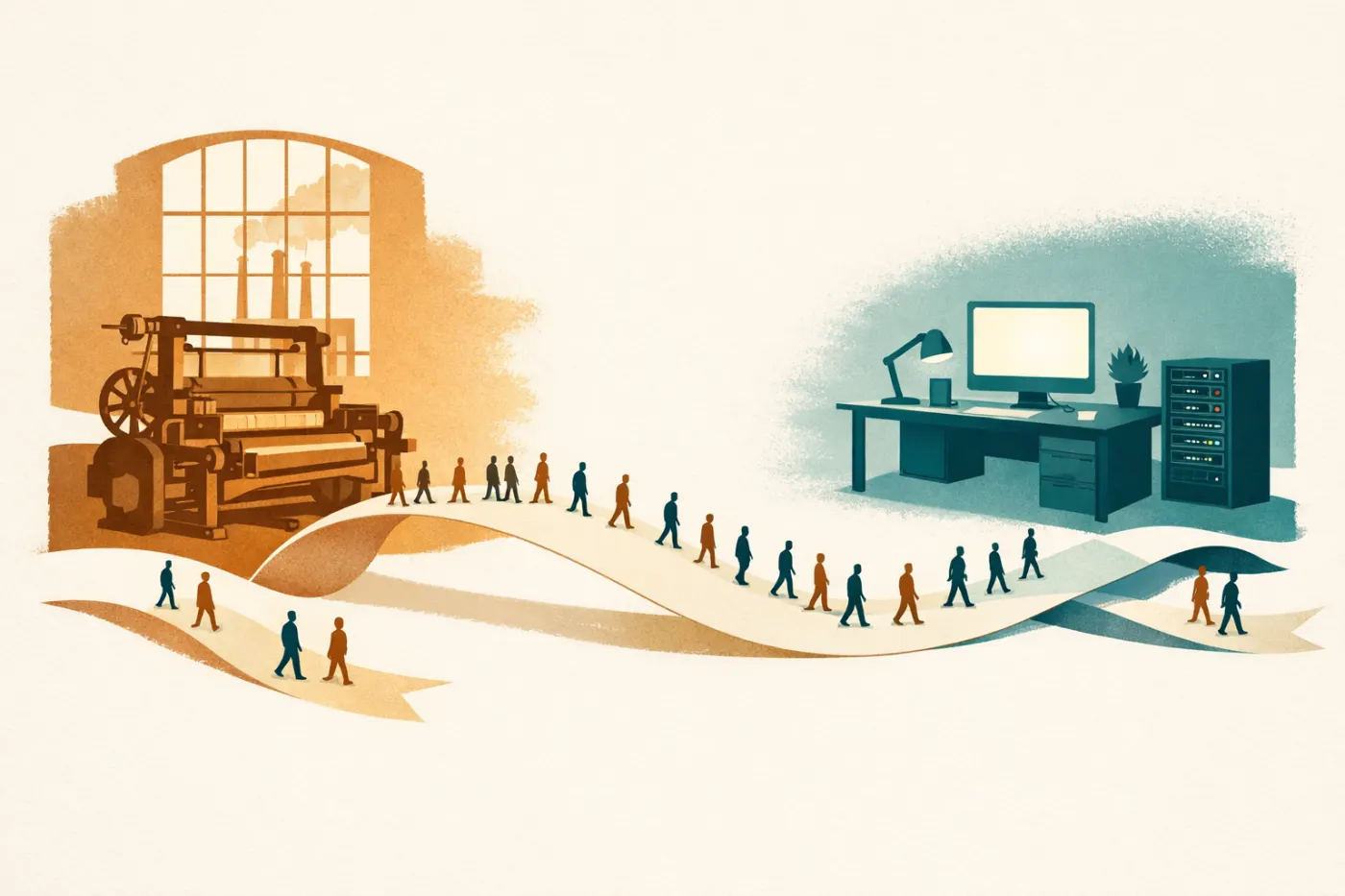
Every generation since the first power looms has been told that machines were about to end work. In the aggregate the prediction has failed every time: employment recovered and usually grew. For specific occupations it has often been right, and in the one case where it was most right, the handloom weavers, the adjustment took forty years and halved the pay of the people living through it.

The cases

6 episodes
  1. 1811

    The Luddites and the handloom weavers

    Croppers and framework knitters broke machines in the English Midlands and North as mechanised cloth-finishing and weaving undercut their trades.

    What happened next: The protests were crushed by 1816, but the weavers' fate was slower. Some 240,000 handloom weavers in the 1820s saw their earnings fall by more than half over the following decades before the occupation disappeared in the 1850s. Aggregate employment in textiles rose throughout.craft destroyed over a generation

  2. 1930

    Keynes and 'technological unemployment'

    In the first years of the Depression John Maynard Keynes warned of a new disease, 'technological unemployment', as mechanisation outran the discovery of new uses for labour.

    What happened next: The unemployment of the 1930s was a demand collapse, not a machine problem. After the war the United States and Britain ran at near-full employment for a quarter of a century while mechanisation continued.aggregate recovered

  3. 1964

    The Triple Revolution memorandum

    A group of scientists and activists warned President Johnson that 'cybernation' would create a permanent class of the unemployed. The President appointed a National Commission on Technology, Automation and Economic Progress.

    What happened next: The commission reported in 1966 that technology 'eliminates jobs, not work'. US unemployment fell to 3.5% by 1969.aggregate recovered

  4. 1970

    The ATM and the bank teller

    Cash machines spread from the early 1970s, automating the teller's core task of handing out money.

    What happened next: The number of US bank tellers roughly doubled between 1970 and 2010 as cheaper branches multiplied and tellers shifted to sales and service. Only after 2010, with online banking, did the occupation begin to shrink.occupation grew, then shrank

  5. 1995

    'The End of Work'

    Jeremy Rifkin's book argued that computers and robots would eliminate most jobs within a generation, and the argument was widely accepted in the mid-1990s.

    What happened next: US unemployment fell to 4% by 2000 and the following decade's job losses came from a financial crisis, not from machines.aggregate recovered

  6. 2013

    '47% of jobs at risk'

    Carl Frey and Michael Osborne estimated that 47% of US employment was at high risk of computerisation within two decades.

    What happened next: By 2019 US unemployment stood at a fifty-year low of 3.5%. Specific occupations the study flagged, such as cashiers and telemarketers, did shrink.aggregate recovered

How these cases resolved

Aggregate employment recovers; a specific occupation shrinks over a decade or two80%
Prolonged displacement of a defined class of workers over a generation20%

Share of the 6 cases above that resolved this way. Small samples: treat as a prior, not a forecast.

Signals that mark this pattern
  • A widely read estimate of the share of jobs 'at risk'
  • Firms citing the technology when announcing cuts before the technology has delivered
  • A specific, identifiable group of workers whose core task has been automated
  • A government commission or inquiry into the future of work
The lesson
The scare is wrong about the economy and often right about you. The question to ask is not whether work will end but which occupation is this wave's handloom weaver, and how long its decline will take.

Stories echoing this pattern

AI at work rhymes with the Industrial Revolution: what to expect next

Microsoft is offering buyouts to 60,000 staff and the youngest workers in AI-exposed jobs are falling behind. History's three great labour transitions say what usually follows, and where the unknowns hide.

Outlook: Churn without collapse: aggregate employment holds, junior white-collar hiring stays depressed, new titles emerge 45% · 5 years, to 2031
·9 min read