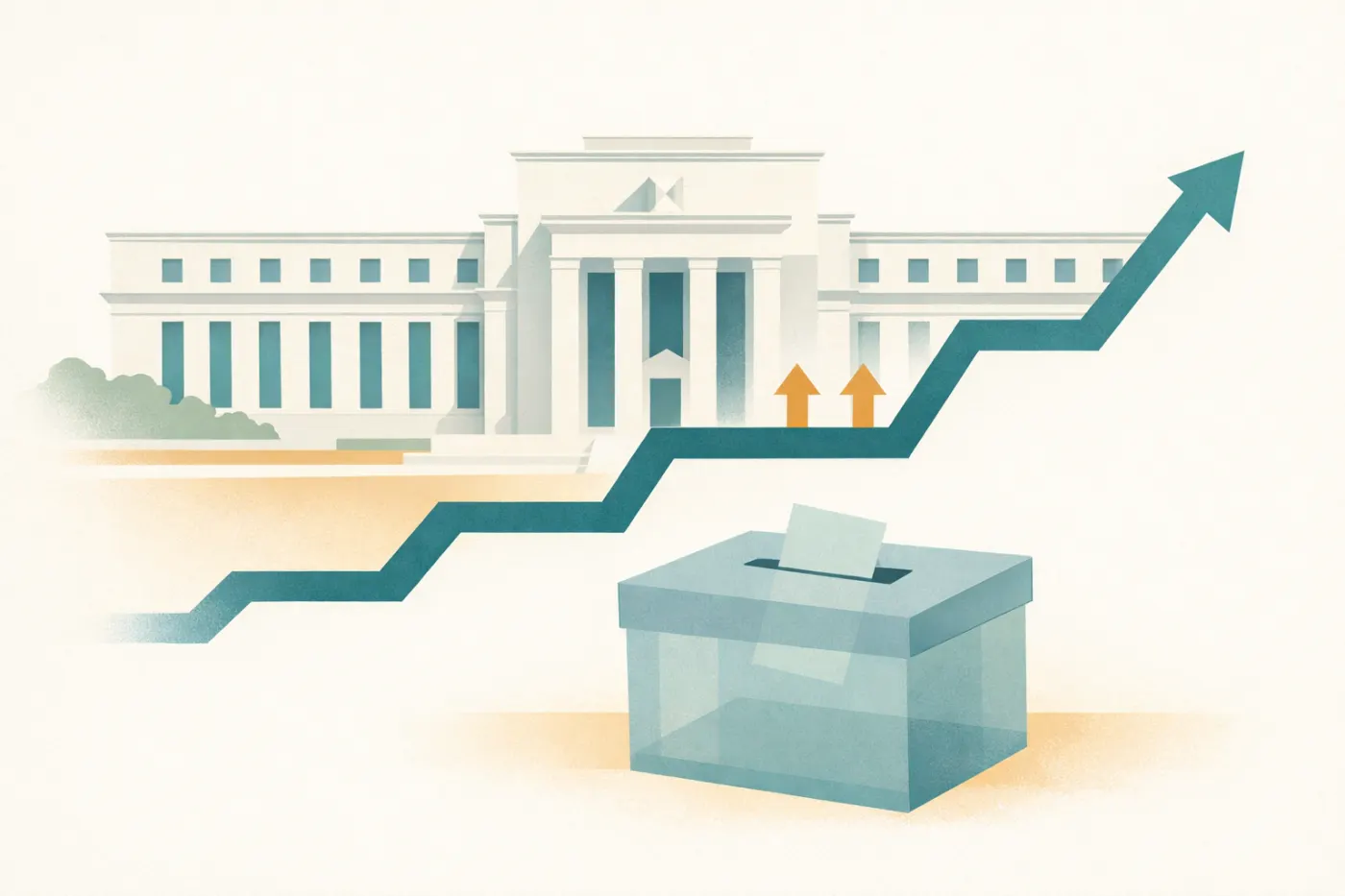
Fed holds at 3.75–4% in a 10–2 vote as two officials push for a hike
The Fed kept rates unchanged a week before the midterms, upgraded its growth language and left December open. Markets, not the statement, are pricing the next hike.
By Rhyme Desk3 min read8 sourcesRhyme index 66
The Federal Open Market Committee left its target range at 3.75% to 4% on Wednesday by a vote of 10 to 2, with Governor Lisa Cook and Cleveland Fed President Beth Hammack dissenting in favour of a quarter-point increase.
What happened
The decision, at the end of the 27–28 October meeting, keeps the funds rate where the Fed put it with a unanimous quarter-point hike in September, its first increase since 2023. The statement upgraded its description of activity from "solid" to "expanding at a strong pace" and repeated that "inflation remains elevated." It dropped September's line that the hike would "support a timelier return" to 2% inflation, replacing it with a promise that "the accumulation of more information will help the Committee determine the policy stance appropriate."
Chair Kevin Warsh declined to say what December holds. "I don't believe in forward guidance absent exigent circumstances," he said, adding that he does not believe in "pre-judging meetings." He said the committee's discussion had "focused mainly on the price stability side" and that financial and credit conditions had "tightened for some businesses and households" since September. Asked about the election six days away, he said politics played "no role" and that he "didn't hear an utterance about politics."
Markets read the hold as a delay rather than a stop. CME FedWatch put the probability of a 25-basis-point hike at the 9 December meeting at 85.7% after the decision, according to CNBC. Stocks were little changed, with the S&P 500 up 0.1% and the Nasdaq down 0.1%. A Reuters poll before the meeting found nearly all economists expected a hold in October and a hike in December.
The dissent is politically charged. Cook is the governor the Trump administration has sought to remove over mortgage-fraud allegations that have not been proven. Treasury Secretary Scott Bessent said this week the Fed should keep "an open mind" about how temporary the current supply shock is, a view that leans against further tightening. CNBC links the inflation pressure to higher energy prices from the Iran war.
Why it matters
Almost everything that matters about this meeting is in what the Fed did not say. The statement kept a tightening lean, two voters wanted to move now, and the chair refused to commit either way. Whether December brings a hike therefore depends on two data releases, the October consumer price index on 10 November and the October minutes on 18 November, and on how the committee reads the credit tightening Warsh himself flagged.
The election timing adds a second layer. A hold a week before the midterms, followed by a hike at the next meeting, is a sequence the Fed has produced before. So is a hold that it insisted was not the end of the cycle, and which turned out to be exactly that.
The rhyme
Five times since 1994 the Fed has paused with inflation above comfort, kept its hawkish language and let markets price the next move. In two of those cases the hike came at the following meeting. In three, the pause was the peak and the next move was a cut. The split below reflects that record, adjusted for one feature today's episode does not share with any of them: this is an early-cycle pause with growth being upgraded, not a late-cycle pause with growth being questioned.
The patterns below are the historical set-ups this story most resembles. The score is a 0–100 measure of how closely the conditions match; the "where it breaks" note is as important as the match.
A central bank stops hiking weeks before an election, keeps a tightening bias in its language, and markets price the next hike for the following meeting. Sometimes the hike comes on schedule. More often the pause quietly becomes the top of the cycle.
ThenIn 1994, 2000, 2006 and twice in 2023 the Fed paused with inflation above its comfort zone, kept a tightening lean in its statement, and in several cases had at least one official arguing to go further. Each time, markets priced the next hike for the following meeting.
NowA 10–2 hold at 3.75–4% with Cook and Hammack dissenting for a hike, a statement that upgrades growth to 'strong' and keeps 'inflation remains elevated', an election six days away and futures pricing an 86% chance of a December move.
Where it breaks: This is a young cycle: one hike in September after a run of cuts, not the end of seventeen increases. Growth was upgraded, not questioned. Both features weaken the 'pause becomes the peak' base rate and push the odds towards a resumed hike.
A president leans publicly on the central bank to keep money easy while inflation is above target. The bank either holds its course, bends, or buys peace with a compromise. The outcome for inflation depends almost entirely on which of the three it chooses.
ThenJohnson, Nixon and Trump each leaned on the Fed with inflation above target and an election near. The bank held firm under Martin and Volcker at a political cost, yielded under Burns at an economic one, and split the difference under Powell.
NowThe administration has tried to remove Governor Cook, who voted for a hike, and the Treasury Secretary is publicly arguing the inflation shock is temporary. Warsh says politics played no role and refuses to give guidance.
Where it breaks: The pressure runs towards easing while the dissenters want tightening, the reverse of the Burns years, and the committee as a whole chose neither. A chair who rejects forward guidance also makes any capitulation harder to detect in real time.